Why water? Why Hydraulics?
12 September 2026
I am not a hydraulic engineer because my father was one. But it is possible that I chose to sail this way because of his love for rivers, and the way he spoke of them as if they were family friends who lived in different parts of town.
Some, he said, were docile and well-behaved — obedient to their course. Others, he would say, were more erratic. A few, utterly treacherous. With the latter, he would often make one thing clear: he was never looking for a fight.
“[in the event of a tussle] there can only be one winner… so I may only nudge.”
Even until recently, when I have tried to draw insights on river management from his years of work in the field, I have had to paddle through such philosophical intonations before getting my hands on some objective solution that I could bring back hastily to my desk in Liège, from where I solve the world’s water-resources problems (for those in doubt, that is a joke).
Surprisingly, though, as I approach the end of my PhD, I am beginning to recognise the benefits — if not the need — for such philosophical grounding in a field such as ours. To work well, one needs more than nice articles in fancy journals. One needs meaning. That meaning could arrive through application, or from the dream-space of honest fundamental research. Regardless of the path, it is my belief that every true-to-their-work river scientist has, at least once, even if only for some fleeting moment, thought of the River as a living entity.
Even those who actively reject the idea, or denounce such language, I have heard, in a moment of impulse, speak of a river along precisely those lines.
Of course, a river is not a living being. But there is something very real about the death of a river. I mean no offence, but the collapse of a structure is not quite the same thing, somehow. I cannot claim to know what distinguishes the two, but my feeling is that a river is living by virtue of all the life that rests within it, and all the life that it enables by lending its resources — of which, it is good to remember, there are others besides water. So,
Why water?
I suppose the answer is that I have come to realise, beyond the clichés, that water really is life — in every possible sense in which that word can be meant.
On the other hand, the answer to “Why hydraulics?” is less emotional, at least to begin with.
You see, most bachelor’s degree programmes in civil engineering lean heavily towards structural engineering. I believe this is true in many countries around the world. My university was no different. The vast majority of our semesters were dominated by the theory and design of structural subjects. Water-resources subjects such as hydrology or open-channel hydraulics featured so infrequently that catching a glimpse of them on the semester timetable was almost an event in itself.
At that point — and perhaps even now — the deterministic nature of structural engineering irked me. I had no instinct for what remained to be understood, or what problem in the field I might solve that was not merely another reflection of human beings wanting to reach greater heights (pun intended).
A pivotal moment came in the form of a summer internship I did at a neighbouring institute during the second year of my bachelor’s. I worked with a professor and a then-PhD candidate (now a professor too) on a problem involving the erosion of a channel's bed downstream of a hydraulic jump.
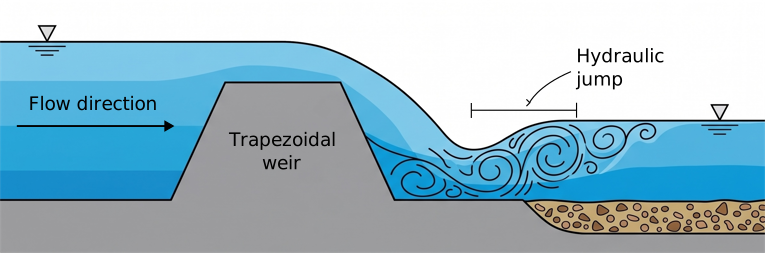
We did a lot of CFD using OpenFOAM. I knew what a hydraulic jump was, how to calculate pre- and post-jump depths, and things of that sort, but I was completely new to CFD. Figuring my way around OpenFOAM was certainly one of the most painstaking yet rewarding journeys of my life. The joy of watching the motion of a fluid unfold on my laptop screen was unbelievably intoxicating.
Two distinct moments from that internship remain fresh in my memory. They were, in their own ways, the final nudges I needed to become forever obsessed with the subject.
The first was during an experimental run — a physical one, involving a flume, a weir, and a sediment bed downstream. The water ran through the flume, over the weir, and into the hydraulic jump. The professor and I were a little further downstream, squatting to observe the sediments and how they were eroding.
“You see, some of them get dragged along as expected,” he said. “These other ones, however — see how they pop upwards before they are taken by the flow?”
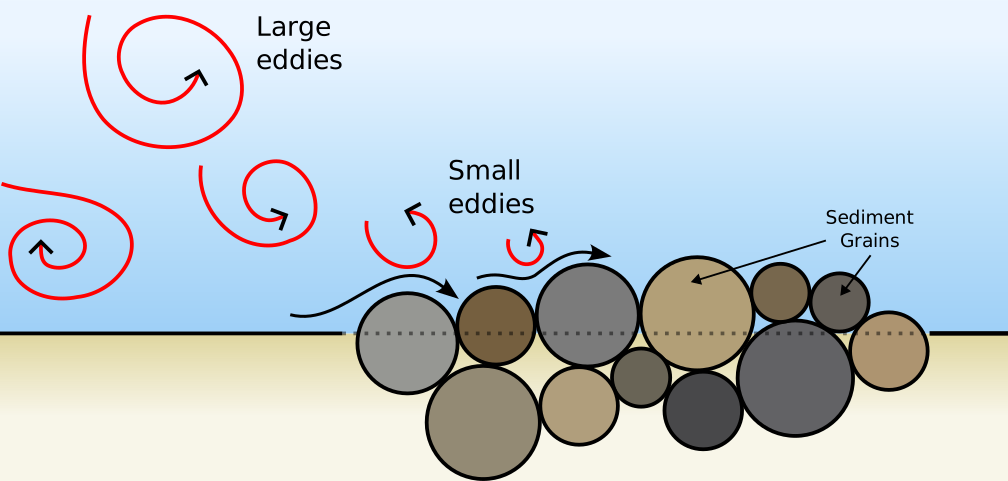
I don’t think I had ever looked at flowing water at that level of detail. But yes, there it was: a sediment grain here or there springing upwards for no intuitive reason.
“There are tiny eddies at play,” he said, “but we do not understand their behaviour yet.”
That moment stayed with me. We do not completely understand how something, seemingly so trivial, happens.
The other moment was along similar lines, this time with the PhD candidate I was working with. We would regularly take afternoon walks for some respite from the glare of our screens. During these walks, he would tell me about the history of our field and fluid mechanics in general, but in no particular order.
On this particular day, he told me the famous quote attributed to Heisenberg:
When I meet God, I am going to ask him two questions: why relativity? And why turbulence? I really believe he will have an answer for the first.
That was that.
To state it plainly, I realised quickly that there is an unending romance in the study of water and how it flows.
You see, unlike structures, roads, and things of that sort, rivers flow where they do because millennia of natural processes have dictated so. More importantly, wherever they may flow, they obey some of the most elegant laws of nature. We play with equations that we have discovered, refined, and used for centuries, while knowing full well that we do not yet understand everything they describe — maybe we never will.
But we try. And in that, there is such joy.